Ask what E85 is worth on a big turbo engine and you get one of two answers. Either it is magic, or it is 30% more fuel for 30% more power. Neither is much use if you are trying to decide whether to plumb in a flex sensor.
On my car the honest answer turned out to be more interesting than either, and it took two ignition tables and a dyno sheet to see it. The short version: E85 buys boost and it buys ignition timing, and depending on where you look in the rev range you can measure both, one, or neither.
Configuration
Status: Verified
- 2JZ-GTE VVTi, 3,353 cc, 9.5:1 static compression
- Kelford T202-D camshafts, 272°/278° advertised
- Pulsar G42-1200, 73 mm compressor, T4 divided 1.15 A/R
- Emtron KV12, firmware 2.20.22, flex fuel with an ethanol content sensor
- Twelve CP1000 injectors, staged, on a 4 bar 1:1 rising rate regulator. That fuel system is what makes 2.8 bar possible at all, and it is covered separately in Twelve Small Injectors Instead of Six Big Ones
- ZF 8HP70, 5th gear, 1.285:1
- Dynojet, WinPEP 8, uncorrected, 6 March 2026 at SRD Tuning
- Both runs: same session, same equipment, same correction factor
The two runs
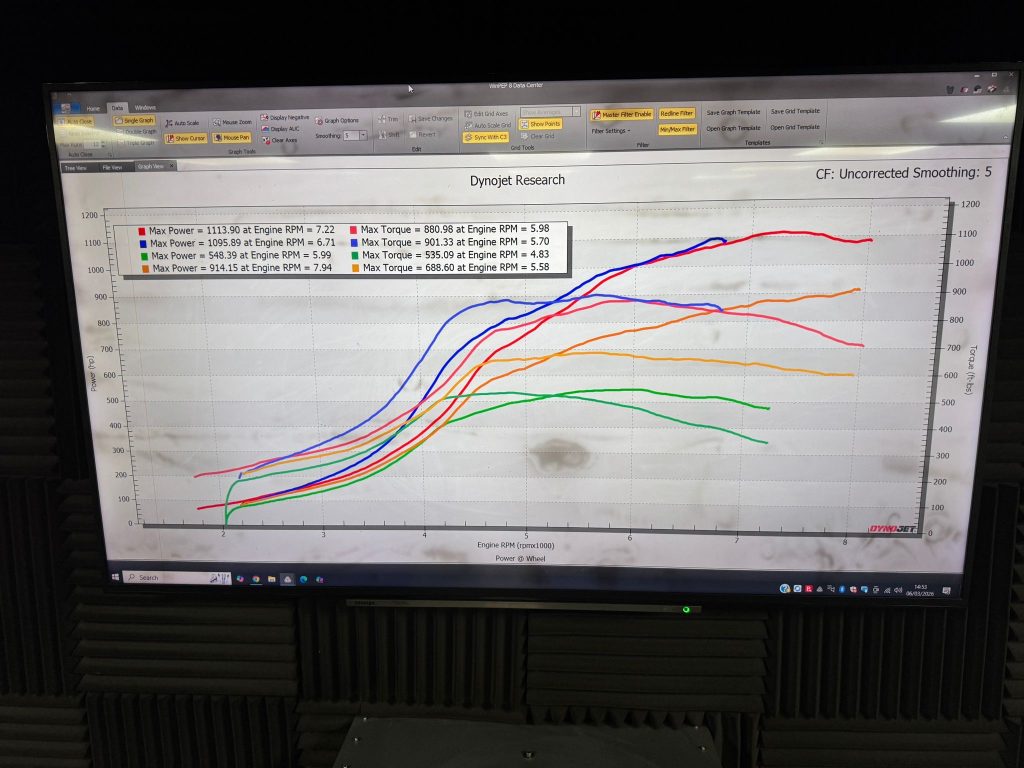
| 99 RON pump | E85 | |
|---|---|---|
| Boost | 2.1 bar gauge (311 kPa) | 2.8 bar gauge (381 kPa) |
| Peak power | 914.2 whp at 7,940 rpm | 1,113.9 whp at 7,220 rpm |
| Peak torque | 688.6 lb ft at 5,580 rpm | 881.0 lb ft at 5,980 rpm |
200 whp apart. The obvious reading is that E85 is worth 200 whp. It isn’t, and the two runs weren’t at the same boost, so any straight comparison between them is measuring two things at once.
What the ignition tables say
Two main ignition tables, same axes, one for each fuel. Comparing them cell by cell gives a much cleaner answer than the dyno does.
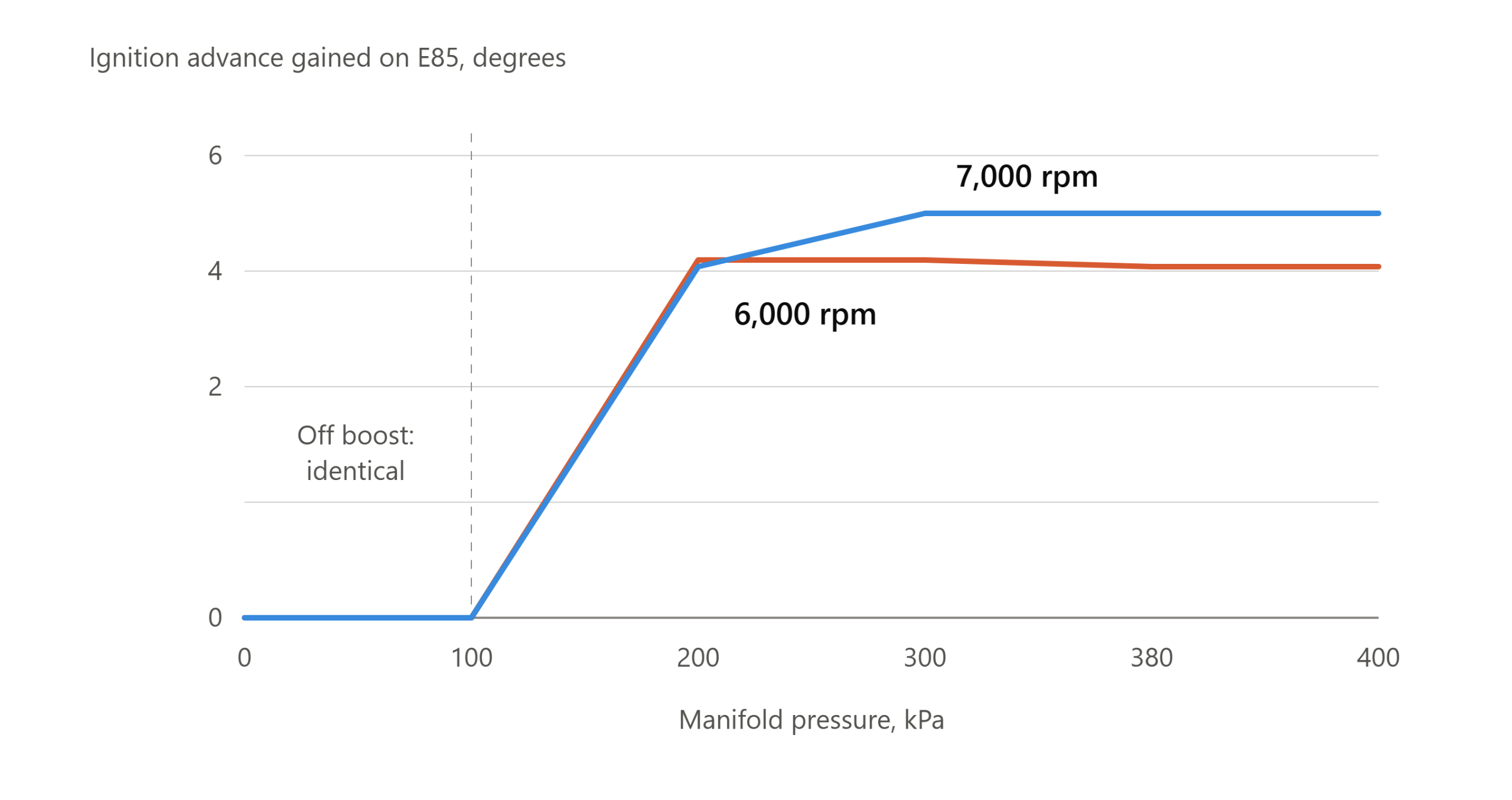
Below 100 kPa, the two tables are identical. Not similar. The same numbers in every cell.
That is deliberate. Off boost the car runs the same timing regardless of what is in the tank, so it idles the same, pulls away the same and behaves the same in traffic on either fuel. A car that drives differently depending on what you last filled it with is a car you have to think about, and this build is meant to be one you don’t.
Above 100 kPa they separate, and they separate by a remarkably consistent amount:
| MAP | At 6,000 rpm | At 7,000 rpm |
|---|---|---|
| 200 kPa | +4.2° | +4.1° |
| 300 kPa | +4.2° | +5.0° |
| 380 kPa | +4.1° | +5.0° |
| 400 kPa | +4.1° | +5.0° |
Four to five degrees, right across the boosted region, holding all the way to the limiter. That is what E85 actually bought in this calibration, and it is a separate thing from the extra boost.
Separating the two effects
To a first approximation, mass flow through an engine scales with manifold pressure. So if you know the pressure ratio between two runs, you know roughly how much of the power difference is just boost.
381 kPa against 311 kPa is a pressure ratio of 1.225. Anything above that is coming from somewhere other than pressure.
At peak torque, 881.0 against 688.6 lb ft is a ratio of 1.279. That is roughly four percent more than pressure alone explains. That four percent is the timing.
At peak power, 1,113.9 against 914.2 whp is a ratio of 1.219. Slightly below the pressure ratio. The timing advantage is still sitting in the table, four to five degrees of it, but it has stopped turning into power.
Why the advantage disappears at the top
Status: Working conclusion
The working explanation is the turbo. At 2.8 bar the G42-1200 is at or near the limit of what it can flow, so the E85 run stops gaining before the engine does. The pump run at 2.1 bar still has compressor headroom, which is why it makes its peak power 720 rpm further up the rev range, at 7,940 against 7,220.
That looks backwards until you think about it. The lower boost run revs out further because it hasn’t run out of compressor yet.
I can’t prove it. Turbo shaft speed isn’t logged on this car and there is no exhaust manifold pressure sensor, so I can distinguish neither the compressor side nor the turbine side from the data I have. It is a working conclusion, and it stays one until there is a sensor behind it.
What this means if you’re deciding on flex fuel
The useful conclusion isn’t the 200 whp. It’s where the 200 whp comes from and where it doesn’t.
If you are already boost limited by your turbo, E85’s timing advantage will show up as mid range torque and very little else at the top. You will feel it on the road far more than you will see it on a dyno sheet, because the road is where mid range lives.
If you have compressor headroom left, E85 lets you use it, and then you get both.
And if somebody quotes you a fuel-to-fuel power comparison without telling you the boost on each run, the number means nothing. Two runs at different pressures measure two variables. You cannot attribute the difference to the fuel unless you hold the pressure constant, or do what I have done here and work out how much of it pressure alone would explain.
The experiment I haven’t run
The clean version of this test is both fuels at the same boost. Set 2.1 bar, run pump, run E85, and the entire difference is the timing with nothing else in the way.
That’s a dyno session I haven’t had, and until I do, the four percent figure above is arithmetic rather than a direct measurement. When it happens it goes on this page and if the number is different I will say so.
The 881 lb ft in the table above is not the highest figure from that session. A fourth run reached 901 lb ft and found the limit of the gearbox instead: Where the Stock ZF 8HP70 Gives Up. Engine torque has been capped at 880 lb ft ever since, which is why the E85 figure is where it is.
Full specification, both dyno sheets and the measurement conditions are on the Supra project page.
If you have run the same engine on both fuels at matched boost and have the numbers, I would like to see them. Same boost, same dyno, same session. It is a surprisingly rare test.