Last verified: April 2026, against the Emtron configuration file JDG 2JZGTE 3.4 VVTi 2026-04-03-01.ecf.
Development objectives
80% fast road, 20% track. The power figure is not the objective. Response, traction, predictable braking and the ability to cover long distances are. A civilised idle and good off-boost driveability are requirements, not afterthoughts. Every decision recorded on this page is judged against that.
Engine
Status: Verified
- 2JZ-GTE VVTi, 3,353 cc (87.0 mm bore, 94.0 mm stroke)
- SRD Tuning 3.4 stroker build
- 9.5:1 static compression
- Carrillo rods, stock length 142 mm
- Rod ratio 1.51 (stock 1.65)
- Kelford T202-D camshafts: 272°/278° advertised at 0.10 mm, 236°/240° at 1.00 mm
- Net valve lift 9.95 mm intake and exhaust, 1:1 rocker
- IVO 8° BTDC, IVC 48° ABDC, EVO 60° BBDC, EVC 0° TDC (at 1.00 mm)
- Intake centreline 110° ATDC, exhaust centreline 120° BTDC, LSA 115°
- +1.0 mm oversized valves, intake and exhaust
- Kelford KVS02-BT dual valve springs
- OEM Toyota VVTi phaser, 40° crank authority on the intake cam
- Idle 1,000 rpm
- Rev limit 8,600 rpm
Induction, boost and exhaust
- Pulsar G42-1200, 73 mm compressor
- T4 divided turbine housing, 1.15 A/R
- SRD Tuning single turbo exhaust manifold, T4 divided flange
- Turbosmart 60 mm external wastegate
- Boost control by a single solenoid on Auxiliary Channel 3
- Plazmaman intake manifold
- Bosch drive by wire throttle body, 82 mm
- ETS 5 inch intercooler
- SRD Tuning 102 mm downpipe
- Garage Whifbitz 102 mm dual silenced exhaust
1.15 A/R is the middle option. A smaller housing would spool harder and run out of breath at the top, a larger one would chase peak power at the expense of everything below 4,000 rpm. The choice made here is the clearest single expression of the 80 percent fast road objective anywhere in the specification.
Cam phasing and dynamic compression
Status: Working conclusion.
The Toyota VVTi phaser parks fully retarded and is advanced by oil pressure, so the cam angle target counts degrees of advance from the parked position.
Taking the Kelford card timing as the parked position, intake valve closing at 48° ABDC gives a dynamic compression ratio of 8.49:1. At the full 40 degrees of advance, IVC moves to 8° ABDC and DCR rises to 9.47:1, effectively the static ratio, because the valve is closing almost at bottom dead centre.
The target map is driven by engine speed. Above 100 percent efficiency it is load independent, so the same cam timing runs at 2.8 bar of boost as at light throttle. Roughly 8 degrees at idle, a 40 degree plateau across 3,000 to 4,000 rpm, then falling away steadily to zero from 8,500 rpm.
That puts peak dynamic compression in the mid range, where the engine makes its torque. At 5,980 rpm the target is around 24.5 degrees, giving roughly 9.26:1. By 7,220 rpm it has fallen to about 11 degrees and 8.91:1.
So the phaser is a cylinder filling strategy rather than a knock strategy. It puts the highest dynamic compression exactly where cylinder pressure is highest. That the engine tolerates 2.1 bar gauge on 99 RON at around 9.26:1 dynamic is down to charge cooling, the ignition tables and the fuel, not to the cam.
One assumption underpins all of the above: that the Kelford card timing corresponds to the parked, fully retarded position. If it was degreed elsewhere, the whole range shifts.
Fuel system
- Twelve CP1000 injectors, staged, on the Plazmaman manifold
- Rated 1,000 cc at 3 bar. At 4 bar static that is approximately 1,155 cc each, giving roughly 13,900 cc/min installed
- Six primary and six secondary, addressed individually per cylinder across twelve dedicated injection channels on the KV12
- Primary carries idle, town driving and low load. Secondary stages in under load
- Three Walbro 485 pumps, on three separate ECU pump outputs
- Aeromotive regulator, 4 bar static, 1:1 rising rate, so full differential pressure is held across the injector at boost
- -10 feed lines, custom fabricated by SRD Tuning
- Flex fuel, with an ethanol content sensor on Digital Input 8
- Fuel pressure and fuel temperature both sensed
Twelve small injectors rather than six large ones is a deliberate choice. Installed flow is equivalent to six 2,300 cc injectors, but at idle and low load only the primaries fire, so the minimum controllable pulse width is that of a 1,000 cc injector rather than a 2,300 cc one. Full flow at 1,114 whp without the low speed driveability penalty that comes with very large single stage injectors.
Rail pressure reaches roughly 6.8 bar at peak boost with the 1:1 regulator. Fuel pressure has been confirmed to hold through full load E85 pulls. The third pump exists for that margin.
Engine management
Status: Verified
- Emtron KV-12, serial 10071, release date 16 August 2023
- Firmware 2.20.22, boot code 1.2
- Hardware version 3.4
- Parameter definition version 1.29.0
- FPGA logic 1.20 B, FPGA firmware 1.90 B, FPGA hardware 1.60 B
- Cruise Control build installed
- 3D printed ECU case and custom engine wiring loom, both by SRD Tuning
- Bosch 82 mm drive by wire throttle, dual servo position feedback, dual pedal position sensors, dedicated DBW power relay
- Zestek CAN Hub steering wheel, replacing a CAN keypad
Sensing
- Manifold pressure, boost pressure, and internal barometric pressure
- Inlet air temperature, engine temperature
- Engine oil pressure and oil temperature
- Fuel pressure and fuel temperature
- Ethanol content
- Six individual exhaust gas temperatures, one per cylinder, via an Emtron ETC8M on CAN
- One wideband lambda, on the internal controller
- Four individual wheel speeds
- Three axis internal accelerometer: lateral, longitudinal and vertical
- Gearbox input shaft speed, output shaft speed and transmission oil temperature, all over CAN
- Intake cam position, single bank, with a single intake VVT solenoid, which is correct for the VVTi 2JZ
- Not fitted: turbo shaft speed, exhaust manifold pressure, pre-throttle pressure
Control functions configured
- Torque model, with a dedicated enable channel
- Traction control: eight position rotary, mode switch, disable switch, and separate active and off warning bulbs
- Anti lag, plus rolling anti lag with its own arming switch
- Cruise control: enable, cancel, set and coast, resume and accelerate
- Boost control on a single solenoid
- Power steering solenoid control, switchable from the wheel
- Gearbox interface over CAN: torque request from the TCU, blip percentage, converter slip and shifter mode
- Downshift and fast and soft gear change channels
- Immobiliser logic and engine safety start inhibit
Steering wheel layout
- Top left: horn
- Next across: rolling anti lag enable
- Top right: anti lag
- Second from top right: cruise up and cruise down
- Bottom left: gearbox mode
- Above that: power steering enable and disable
- Left rotary: 8 position traction control
- Right rotary: boost and torque management
- Remaining two: cruise enable, disable and resume
Transmission and drivetrain
- ZF 8HP70, stock internals, stock torque converter
- Fitted with the Garage Whifbitz installation kit, fresh oil pan and fluids
- CANformance CAN TCU, release v1.1 beta 13
- BMW Supra A90 gear selector, mounted in the OEM location
- OS Giken LSD
- 2.93 final drive
- Dedicated gearbox cooling fan output
Engine to gearbox torque mapping has been reworked from the SRD baseline to suit road use. The ECU receives torque request, blip percentage, converter slip and shifter mode from the TCU over CAN.
The stock 8HP70 torque ceiling
Status: Verified. During the March 2026 dyno session a run reached 901 lb ft in 5th, 1.285:1, at approximately 95°C transmission oil temperature, and the clutch packs slipped. Torque was subsequently limited and the final calibration holds 880 lb ft.
The run was in 5th rather than direct drive because of the dyno’s roller speed ceiling. With the 2.93 final drive and the 295/30/19 rear tyre, 8,200 rpm in 6th is roughly 216 mph at the roller, against about 168 mph in 5th.
880 lb ft is applied as a global cap rather than a per gear limit. Below 5th the ratios multiply harder, so the torque model reduces demand there. Above 5th they multiply less, so the model would allow more, and that headroom is deliberately left unused until there is a measured limit for those gears.
The engine is not currently limited by the engine. It is limited by the gearbox, which is why the 8HP75 is first on the development list. Full write-up: Where the Stock ZF 8HP70 Gives Up.
Chassis, brakes, wheels and tyres
- KW Variant 3 coilovers
- Brembo calipers from the Jeep Grand Cherokee SRT8, supplied and fitted via Peter Kop
- Powdercoated by Auto Renew Customs, Liverpool
- Lexus IS-F discs, 360 mm front and 345 mm rear
- Carbotech XP10 pads
- Motul RBF 660 fluid
- Stainless steel braided brake lines
- Rear arches rolled by Arch Enemy
- Front: Rays Volk Racing G025, 19×10 +36, Continental SportContact 7 265/30/19
- Rear: Rays Volk Racing G025, 19×11 +46, Continental SportContact 7 295/30/19
Alignment
Status: Working conclusion. Interim setup, pending Hardrace adjustable hardware and a full alignment afterwards.
- Front: -2.0° camber, 0.06° toe in, 4.2° caster
- Rear: -1.6° camber, 0.32° toe in
Rolling diameters are 641.6 mm front and 659.6 mm rear, a 2.8 percent difference. Any traction control strategy comparing front and rear wheel speed has to compensate for that offset, or it reads a permanent 2.8 percent slip at steady cruise.
Power
Status: Verified
E85, 2.8 bar gauge (40.6 psi, 381 kPa MAP)
- 1,113.9 whp (830.6 kW) at 7,220 rpm
- 881.0 lb ft (1,194 Nm) at 5,980 rpm
- Power holds above 1,090 whp out to 8,200 rpm
99 RON pump, 2.1 bar gauge (30.5 psi, 311 kPa MAP)
- 914.2 whp (681.7 kW) at 7,940 rpm
- 688.6 lb ft (933 Nm) at 5,580 rpm
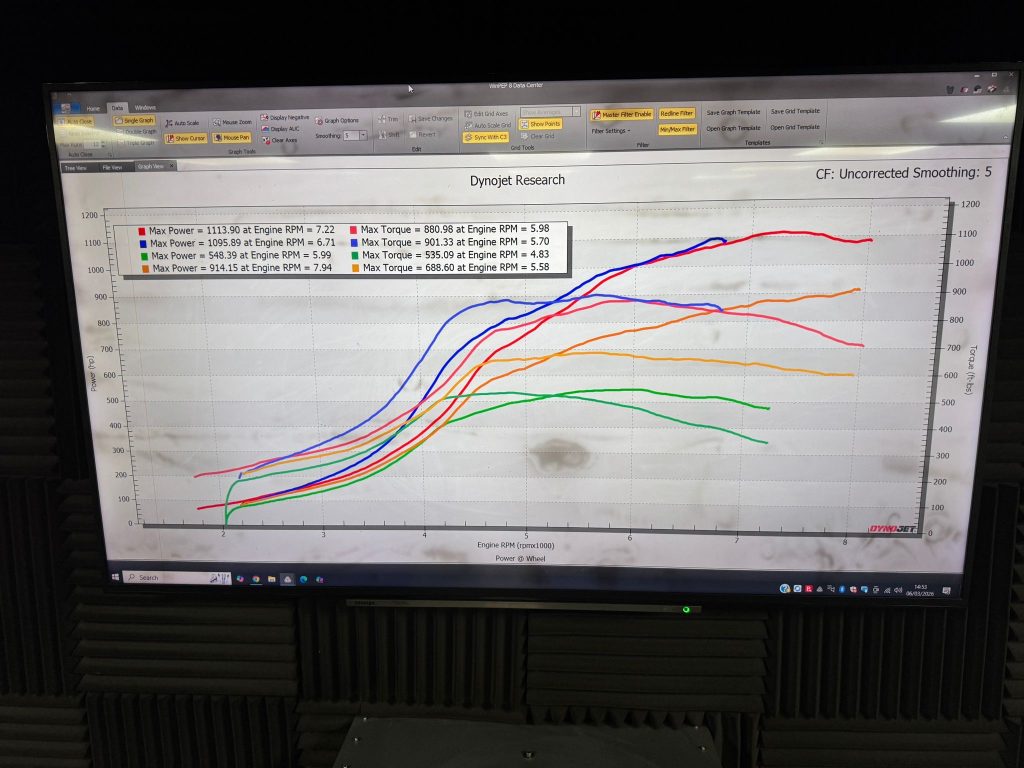
Measurement conditions. Dynojet, WinPEP 8, 6 March 2026, at SRD Tuning. Smoothing 5. All runs from the same session on the same equipment, in 5th gear.
All figures are uncorrected. No atmospheric correction factor has been applied in either direction. These are the raw measured numbers on the day, which on a cold March morning is more likely to understate the figure than flatter it.
No crank figure is published. Converting wheel power to flywheel power requires a drivetrain loss coefficient we have not measured.
Baseline calibration and maximum-effort fuel and ignition maps: SRD Tuning. Subsequent refinement of throttle area, pedal mapping, traction control, idle and shift coordination: John Gaskell.
What E85 buys
Status: Working conclusion.
Two things: boost, and ignition timing.
The two main ignition tables are identical below 100 kPa, so off boost the car runs the same timing whatever is in the tank and behaves identically. Above that the E85 table carries roughly four to five degrees more advance, consistently, all the way to the rev limit.
Where that shows up in the output is the interesting part. At peak torque, 5,980 rpm, the E85 run is 1.279 times the pump run against a pressure ratio of 1.225. The four percent difference is the timing. At peak power, 7,220 rpm, the gain falls back to 1.219, which is pressure alone. The timing advantage is still in the table there; it just stops converting into power, because the compressor is at the limit of its capacity at 2.8 bar.
That last point is inference rather than measurement. Turbo shaft speed is not logged and there is no exhaust manifold pressure sensor, so neither the compressor side nor the turbine side can currently be confirmed.
Previous configurations
2025, 3.0 litre and G40-900. Status: Superseded
- 3.0 litre 2JZ-GTE VVTi, Pulsar G40-900
- SRD Tuning single turbo exhaust manifold, T4 divided flange, carried over to the current build
- T4 divided turbine housing supplied by Pulsar Turbos UK
- Six 1,400 cc injectors, single stage
- 548.4 whp at 5,990 rpm, 535.1 lb ft at 4,830 rpm
- ZF 8HP70 and CANformance CAN TCU as current
- Rays TE37, Yokohama Advan A052
2024, as acquired. Status: Superseded
- Standard 2JZ-GTE VVTi, stock sequential twin turbos
- 355 bhp, 338 lb ft
- A343E four speed automatic, stock differential
- 3 inch decat exhaust, lowering springs on OEM dampers
- Volk GT7 19 inch, Michelin Pilot Sport 4S 265/35/19 all round
Current development priorities
1. Emtron TM16 TCU and 8HP75 gearbox
The gearbox is the current limit on the car, not the engine. The 8HP75 raises the torque ceiling above the 880 lb ft the 70 will hold, and the TM16 moves transmission control onto the same platform as the engine management, replacing the CANformance unit. Both the current configuration and the new one will be documented, along with what changes when engine and gearbox share a manufacturer.
2. Hardrace suspension hardware
Adjustable front upper arms to increase caster from the current 4.2 degrees, and adjustable rear camber arms. A full alignment follows, at which point the alignment figures on this page move from Working conclusion to Verified.
3. Emtron ED10M dash display
Purely because it is cool. No engineering justification offered.
4. Audio
Full sound deadening with closed cell foam and dual panel treatment, then a fully active Audison system. Outstanding problem: finding someone to fabricate A-pillar mounts for the tweeters and mid range. If you build these, get in touch.
This is less of a diversion than it looks. The car is meant to cover long distances, and cabin noise is a road car problem the same way traction is.
5. Front end
Either a new OEM front bumper with a Ridox lip, or the full Varis kit. Undecided, and open to opinions.
Build history
- I did a thing… (acquisition)
- The Supra, So What’s the Plan?
- Mk4 Supra, It’s Home!
- Bulbs, Suspension and Alignment
- Rear Seat Delete
- Supra VVTi | Latest Specs (Status: Superseded)
- The Big Single and 8 Speed!
- TE37 Wheels (Status: Superseded)
- Rival Worx TRD Style Spoiler
- Big Brake Kit
- The 3.4 Stroker Build
Problems and failures
- Stock 8HP70 clutch pack slip at 901 lb ft, March 2026. Torque limited to 880 lb ft as a result.
- Zestek downshift paddle failure
Failures stay on this page. Nothing is removed because the project moved on.